

Ad
RRPD talks elder abuse in public information exchange
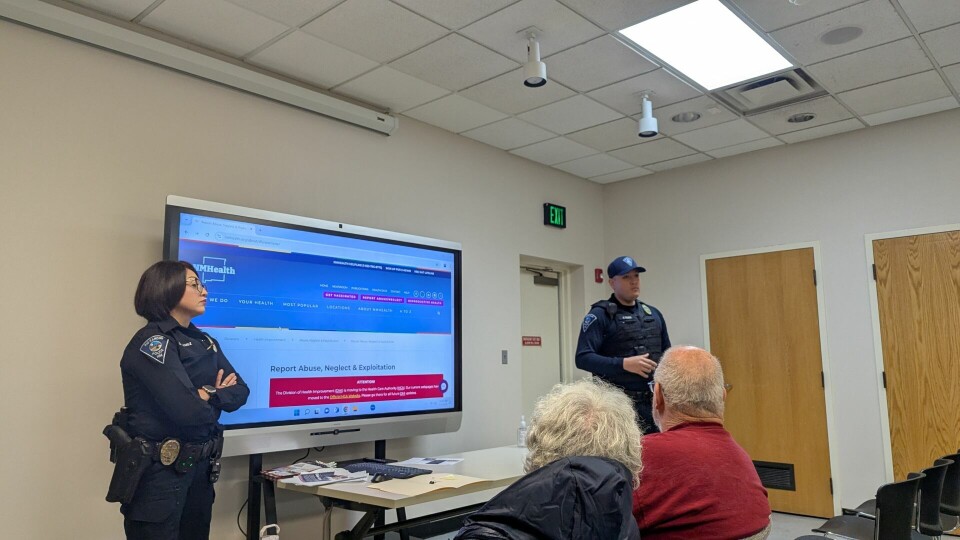
Officers give public information exchange presentation on elder abuse.
Published
Modified
RIO RANCHO — Elder abuse was the topic of the day as the Rio Rancho Police Department held a public information exchange Jan. 11 at Esther Bone Library.
Officers Daisy Gomez and Victor Duran spoke on what to look out for, what to do if it happens and to answer audience questions.
Elder abuse can be hard for police to respond to, and their efforts aren’t always the last step in answering a call for help they said.
“The number of Americans 85 and older is projected to nearly double to 95 million by the year 2060. Nearly 1 in 4 of Americans will be in their golden years, and they deserve to feel safe and cared for,” Duran said, reading off a pamphlet.
He added that approximately 1 out of 10 Americans age 60 or older have experienced some form of elder abuse with about 5 million seniors experiencing it each year.
Duran said that there are different types of elder abuse, including physical, sexual, exploitation as well as the most common type: neglect. He further explained that it is possible for a person to self-neglect, but that is not considered a crime.
“Obviously, we’re not there to incriminate this person because they are our victim, right? But we want to care for those people, too. We want to try and find them the resources that they need and try and figure out,” he said.
There are a number of causes for elderly people to self-neglect, but Duran specifically named lack of funds and mental illness.
The law around elder abuse“This is important for any crime that we investigate because sometimes victims, witnesses, even suspects, family members, they want to know why is nothing being done. Unfortunately, in some cases, our hands are tied. We’re limited on what we can do. So the better relationship, the better exchange and information we can get, the more transparent we can be, the more follow-through we can have with our investigations,” he said. “But I know that that’s that’s a big frustration for everyone. We sympathize with you when it comes to something that’s maybe not law enforcement related.”
He added that RRPD understands people are given the run around and questions aren’t always answered.
Ad
He went into the law, around elder abuse. However, the problems arise in enforcing them.
According to the United States Commission of Civil Rights, there are challenges to enforcement that are inherent in the nature of elder abuse itself.
“Seniors do not report, and when they do, cases are often not criminally prosecuted for many of the same reasons that civil lawyers find it difficult to bring civil actions,” reads in a handout from RRPD.
Additionally, the likelihood of proving abuse occurred goes down in these cases, especially when victims, witnesses or suspects don’t cooperate. It also says problems are made worse by lack of community awareness with elder abuse, usually because there is not enough “political will” or “public outrage” to enact protective legislation for elders.
After Duran went into those documents, he offered to answer a few questions.
One woman asked about the time it takes to hear back on a report. Duran said that every entity is different so he doesn’t have exact times. Gomez said that if she hadn’t heard back within a week, she should call the number on the report application sheet. Duran says people can file with police or adult protective services.
Another person asked about anonymity when making a call or report. Duran said that it depends on the extent of the caller’s or accuser’s involvement in the case as well as what type of abuse it is. He said that if they would need to talk to a person, their name would have to be used. Additionally, people have the right to know who has accused them of a crime. He added that if there is extreme fear in those cases, police will work with victims and witnesses and that it is common to have restraining orders put on people. However, Duran stressed that the more information and cooperation they have from everyone in a case, the better.
Case samplesBoth Gomez and Duran talked about specific cases to give examples of elder abuse. Duran talked about conducting a welfare check after a woman called police claiming abuse. When he went to the home, nothing appeared to be in disarray, he said, explaining that a messy or dirty home can indicate abuse or neglect. In this case, the woman retracted her accusations and apologized.
Gomez recalled answering a call for an elderly man wandering on his street in nothing but an adult diaper. In that case, the home was in disarray and she could smell rotting food. When the victim’s son was called, he told her to just put his dad back in the home and lock the door. She told him she wasn’t leaving until the man was cared for. He continued to say that the door locks both ways and that his dad won’t get out.
“So that’s neglect,” Gomez said.
However, in some cases, police aren’t enough. Adult Protective Services can help in getting the victim into a better situation.
For information on elder abuse or filing a report on adult protective services, visit nmhealth.org. People can also check out elder care.acl.gov. In emergencies, call 911 or 505-891-7226.


